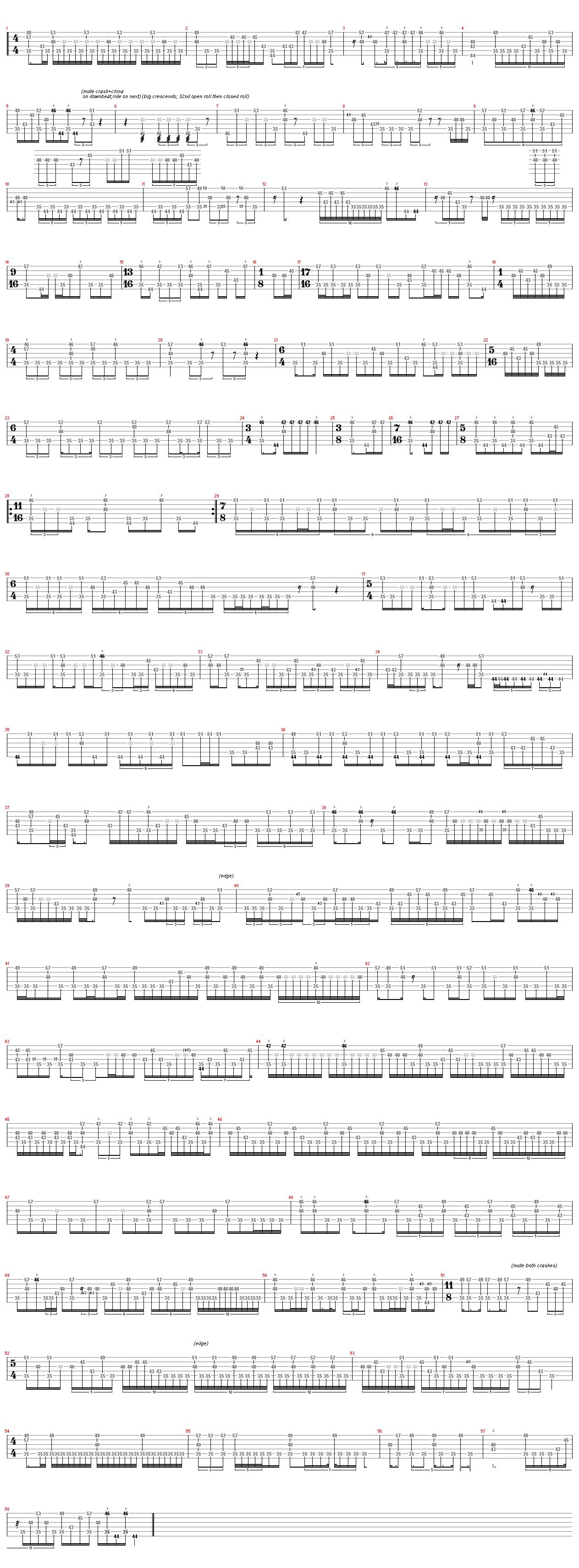
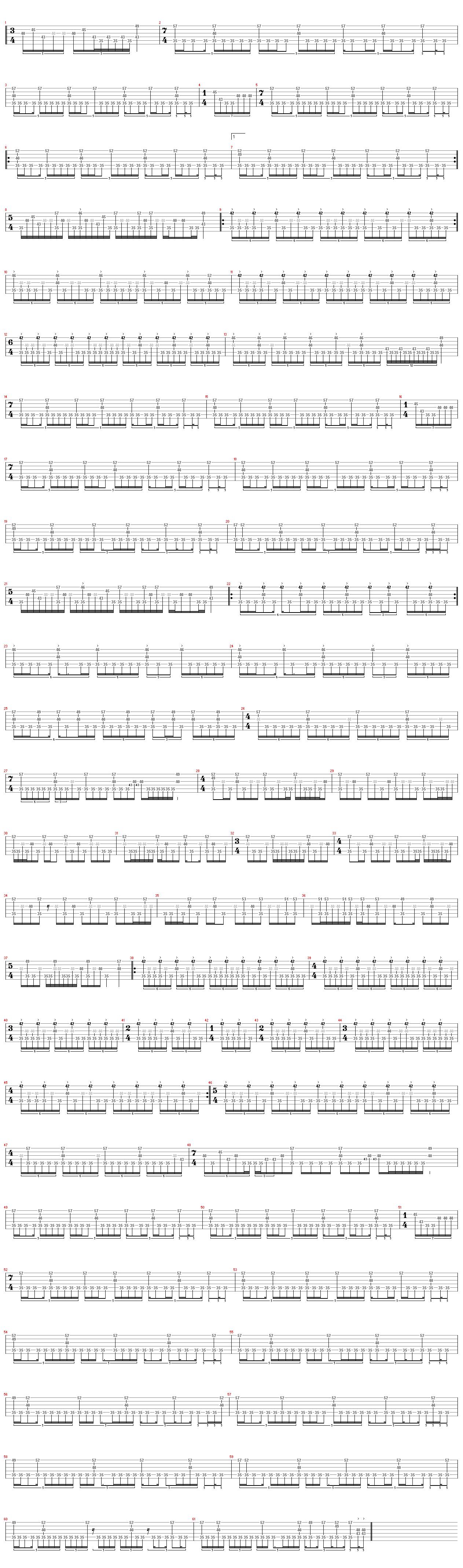
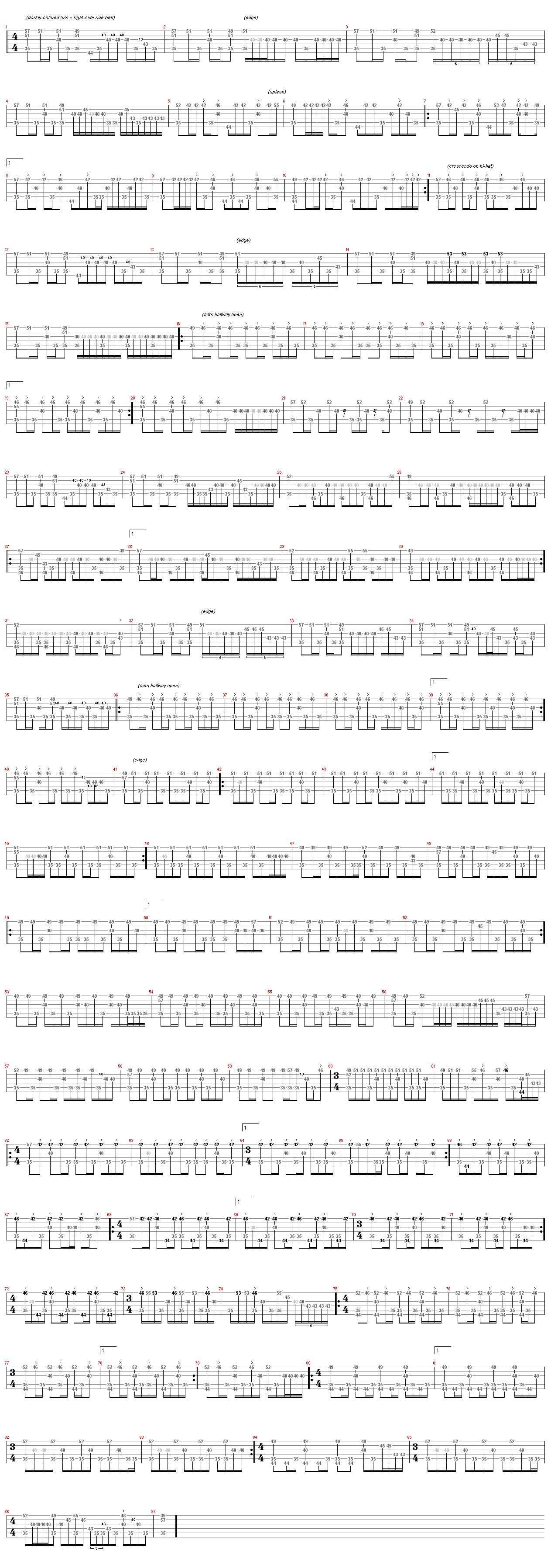
I was recently hired to transcribe and create sheet music for six songs by City and Colour (two from each of their albums). My transcriptions of these songs are for sale at their official website and can also be found below:
On the subject of transcriptions, Trey Gunn of King Crimson discovered and praised my transcription of the band’s ‘The ConstruKction of Light’:
Amazing! King #Crimson transcription> “The ConstruKction of Light”. This guy did his homework. Click to Dload score. youtu.be/6kd5kG4847I
I created this transcription of ‘The ConstruKction of Light’ for my senior comprehensive music exam at Swarthmore college. It was performed in a quartet arrangement, with myself on drums and vocals, Tony Blekicki and Swarthmore physics professor Carl Grossman on guitar, and Ben Rachbach playing the Warr Guitar part on a keyboard. Unfortunately, the performance was not recorded.
Note that the guitars and the Warr Guitar sound an octave below where written.
I also recently created piano arrangements of two songs by Animals as Leaders.
If you like what you see here, know that I am available for hire! I can offer a number of transcription/copying services (creating sheet music for your band from an audio file, creating digital scores from handwritten scores, transposing scores) in addition to session vocals and keyboards, production, arrangement, and composition. If you would like to hire me for any of this or can think of anything else you’d like to have me do, please email thegabrielconstruct@gmail.com and I can send you my resume!
If you would like sheet music for Interior City, the full score and parts books for piano, drums, bass, guitar, saxophone, and violin are for sale on the stores page.
Gabriel’s Notes: You can hear influences from Failure, drum-n-bass, barbershop quartets, Debussy, and more in this 10 minute song which alternates between full band sections and stripped down interludes (mostly solo piano). Thanks to the song’s frequent tempo changes and numerous sections in free rhythm (which are thus of indeterminate length), it had to be tracked in multiple chunks and somewhat out of order. This song contains the oldest music on the album – I actually wrote the piano part in my sophomore year of high school, nearly 10 years ago. It was only the second piece I ever wrote for live instruments, with Inner Sanctum being the third, written immediately afterwards. They were originally conceived together as part of a disastrous 30 minute long solo piano suite, which has also served as the source material for three songs that will appear on the next two TGC albums. While creating a full band arrangement of Defense Highway in the year leading up to recording, I revised its structure, removing some parts (which became another 11 minute long song) and adding a piano interlude based around the chord progression which ends Inner Sanctum.
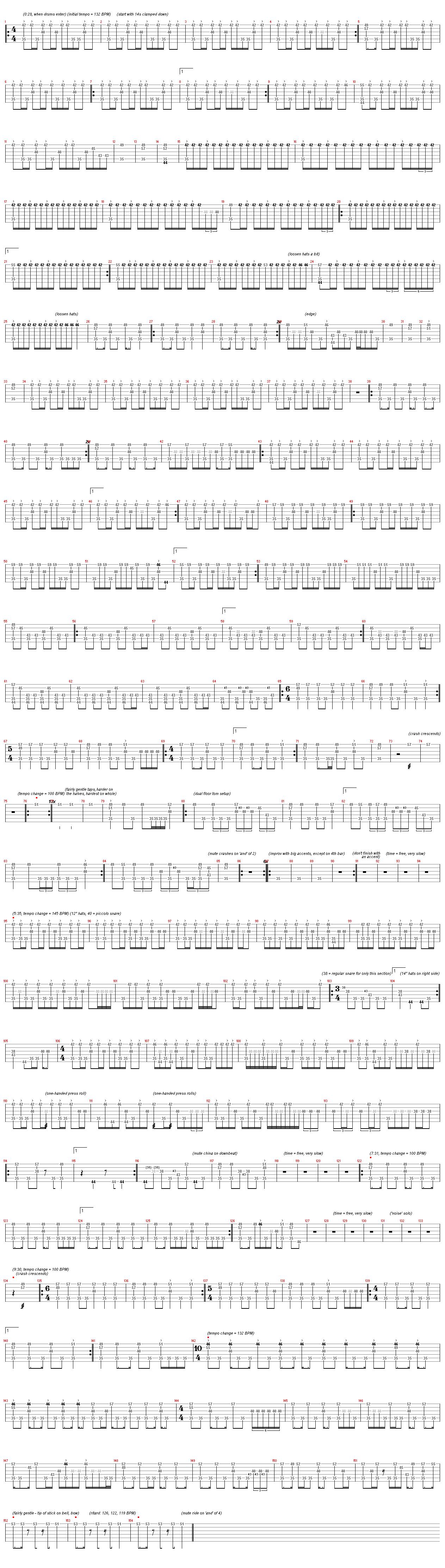
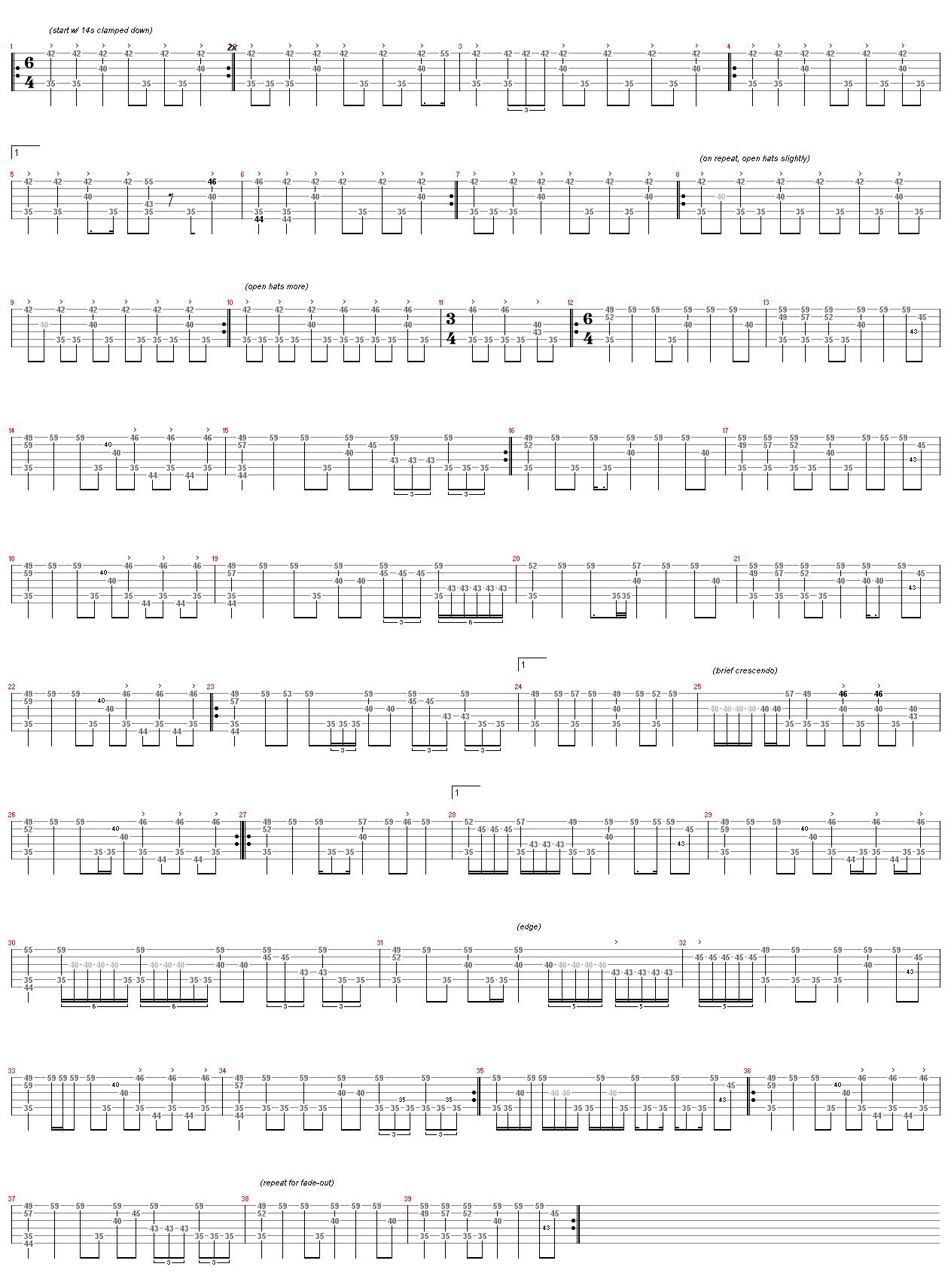
Travis’s Notes: There’s much to say about this one, so I’ll begin with the gear. The tune starts with the same setup as “Subway Dwellers” (except w/ my flat ride on the right), switches to dual floor toms for the big mid-song climax, back to rack/floor for the first drum solo (more on that later, of course), a hybrid style kit consisting of 12″/14″ MDM hats, my 4″x14″ Pearl maple piccolo snare (same one I used on SD, but tensioned high) and Reference brass snare for the drum ‘n’ bass section, and finally back to the regular kit for the ‘noise’ solo and the rest of the tune.
Once the drums enter at 0:28, it stays upbeat and energetic until the first tempo change. There’s some dual ride stuff at 2:40 – 2:42 and a brief ‘chick – splash’ pedal hat ostinato at 2:57 – 3:04. For the big mid-song climax, I felt that the dual floor tom setup would generate a more powerful and dramatic feel. The cymbal mutes at the close of this part (4:32) complement the very next piano note that follows. (You can see me grabbing the china before as well so it doesn’t bleed into the mics – that one isn’t ‘timed’, heh).
For the first drum solo, I didn’t write anything ahead of time but I figured out what I wanted to do just before we recorded. There’s a bit of improv within the transitioning to each part, similarly to the bridge in Pete P’s “Death Country”. It was important to do it this way, as the accents are crucial to the piece (one on the downbeat of every bar but the fourth, then nothing on the downbeat at the end). When we tracked this I had Garrett loop the click, I went for it several times and we kept the best take. You can see me motioning to Gabe a ‘meh’ sort of hand signal regarding the take I had just completed before launching into the one that made the album, haha. I think those are 16th septuplets at the very end. Anyone wanna transcribe this for fun?
I had a bunch of fun writing parts for the drum ‘n’ bass section. Originally, Gabe wanted a simple part underneath and a crazy part overdubbed, but I made it my goal to write something so bitchen it nearly sounded as if two drummers were playing, hehe. Gabe really highlighted this and brought it out with his amazing use of panning. The transitional sections are played on my regular brass snare and larger hats for contrast.
Skipping ahead to the ‘noise’ solo, this one was also a ton of fun, which is obvious if you watch the unabridged version that I’ve tacked on at the end. I think Gabe originally programmed a bunch of gibberish (apologies if not! haha) and I thought it’d be cool to just throw a mess of sticks on my kit and have him run around the room like a madman, making as much noise as possible. I left my other floor tom set up with some cymbals scattered about on the ground for him, plus there was an old, out-of-tune piano in the live room which was perfect, haha. None of this was timed to the click or pre-conceived, of course. We tracked so much stuff that some of it had to be cut in addition to the whole thing being chopped in half and layered on top of the initial half. It was a bit difficult, but I edited my footage to sync up with the first half as best as I could.
Skipping ahead, the song becomes upbeat and energetic upon reverting to its initial tempo of 132 at 10:02. There’s some flashy stuff once I move to the china, including a floor/snare triplet flam – a Colaiuta trademark. The ride bell at the end is played with the tip of my stick for less abrasion, and I move to the bow when the melody drops. The mute at the end is timed to complement the piano.
And as always, there’s even more complementation present:
0:55 – extra snare on ‘and’ of 4, vocals
1:10 – 1:24 – hi-hat accents, vocal melody
1:38 – 1:45 – cymbal accents, bass/distorted piano stabs
3:03 – 3:26 – cymbal orchestration, chord progression
6:06 – 6:15 – cymbal orchestration, vocal melody
7:47 – pedal splash, piano mash
10:06 – 10:11 – low crash/splash, vocal melody
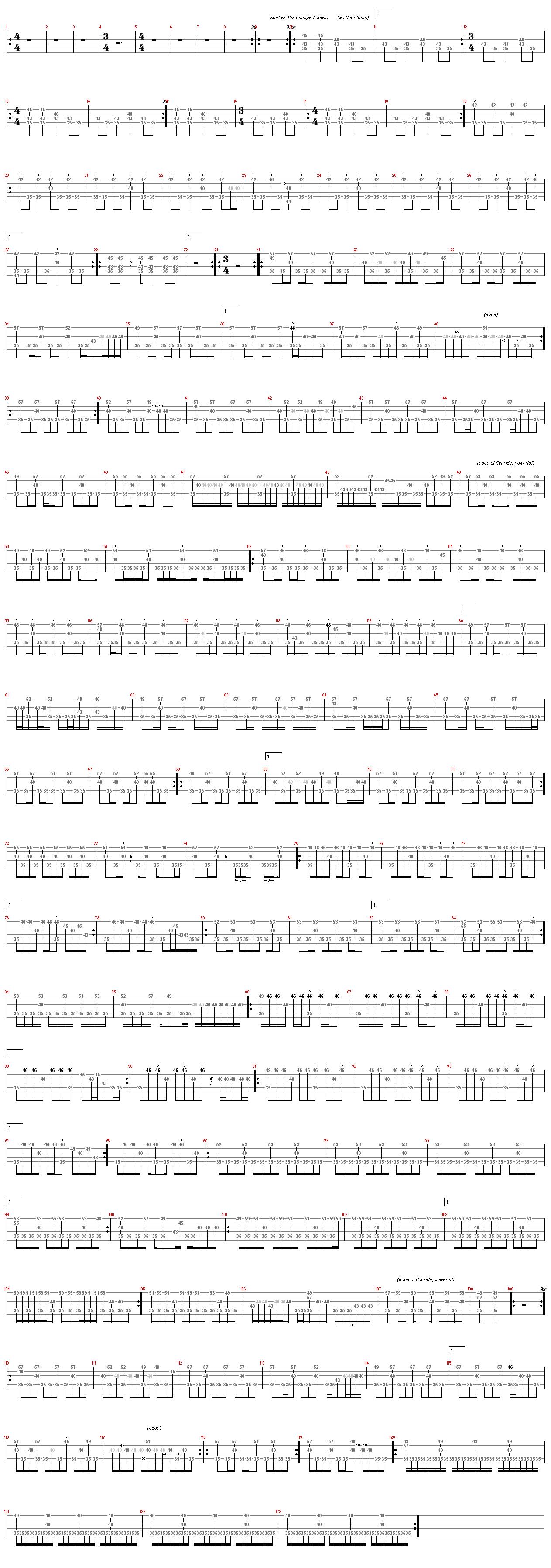
Full drum set transcription
Tempo (0:28, when drums enter) = 132 BPM
Tempo change (3:34) = 100 BPM
Tempo (5:10 – 5:35) = free, very slow
Tempo change (5:35) = 145 BPM
Tempo (6:17 – 7:31) = free, very slow
Tempo change (7:31) = 100 BPM
Tempo (7:48 – 8:26) = free, very slow
No tempo/’noise’ solo (8:26 – 8:50)
Tempo (8:50 – 9:30) = free, very slow
Tempo change (9:30) = 100 BPM
Tempo change (10:02) = 132 BPM
Tempo change (10:26 – 10:32) = 126/122/119 BPM (ritard)
This week, I’d like to take a break from talking about Interior City to share some of my chamber music with you. Here is a video of ‘Between Entwines’, a collaborative work which Sophia Uddin (the violinist on Interior City) and I wrote and performed together.
This video is from our debut performance of the work at the second annual Swarthmore College Student & Alumni Composers Concert in Lang Concert Hall on October 29, 2011.
Program notes: ‘Between Entwines’ was written during the summer of 2011. It began when Gabriel sent Sophia a tiny sketch for her to augment and return. It continued to grow from there, mostly through email correspondence, with some additional work done in chat boxes and in person. It is intended to be the first entry in a series of piano/violin collaborations using the same set of motives.
Sheet music for Between Entwines can be purchased on the Stores page and can be viewed below:
Before Between Entwines and Interior City, Sophia was a member of The Mandelbrot Quartet, who performed some movements I wrote for string quartet. Here is a video of their final performance of these movements at a split concert with the jazz quartet Menage on April 22, 2011 in Lang Concert Hall:
I began writing the quartet with the ‘Interruptions’ movement, a hyperactive expression of crazed joy. The title was actually devised by Gerald Levinson, my composition teacher at the time, as the piece constantly interrupts itself. The harmonic language of the movement (chromatic contrary motion) was inspired by Ligeti’s first string quartet, while the structure was inspired by Stravinsky’s Symphonies of Wind Instruments. ‘Hedonistic Ritual’ is a short, fast and angry movement which was inspired by seeing this Dillinger Escape Plan concert and wanting to bring some of that anarchic energy to a classical concert hall.
Here is The Mandelbrot Quartet’s debut performance of ‘Interruptions’ from the first annual Swarthmore College Student and Alumni Composers Concert in Lang Concert Hall on November 6, 2010:
At the same concert, I participated in a performance of Ben Starr’s vocal composition ‘Assumpta est Maria’:
As a side note, the closing number of the Mandelbrot/Menage concert was a joint performance of Keith Jarrett’s ‘The Wind Up’ with both Mandelbrot and Menage. It’s not often that you get to see a jazz quartet and a string quartet perform together!
There is much exciting news in the world of Travis Orbin! Firstly, he has officially joined Darkest Hour. Secondly, he is recording two solo EPs for release (hopefully) later this year, ‘Projects’ and ‘Silly String’. He has just posted a song from ‘Silly String’ on youtube:
Gabriel’s Notes: The chord progression of the opening theme is a reversal of the progression used in Thelonious Monk’s ‘I Mean You’, and the dominant and tritone harmonies throughout reflect that influence – but the texture is drawn more from ’90s garage rock, only with a distorted piano instead of distorted guitars, as this song features no guitar whatsoever. The bridge features a subtle reprise of the album’s opening song. This is the only song where I didn’t give Tom a basic bass line to work with – just a piano part. I recorded three complete takes of the piano part for this song and then spliced the best parts of each together.
The wall of sound / sonic landscape production style used on Interior City is something I’ve always been drawn to – Strapping Young Lad’s ‘Alien‘ album is a great example. This song has a particularly high quotient of ambient noise behind all of the basic instrumental parts, including many speech samples. However, the chattering that runs through the background of Interior City does more than just add texture – it also serves a purpose in the story, highlighting and contributing to the character’s paranoia.
Travis’s notes: In “Subway Dwellers” — one of the few tunes on the album that possesses more of a pop sensibility — I’m playing some syncopated closed hat parts in the first verse (subtle crescendo beginning at 3:11 to provide a ‘lift’ into the pre-chorus), and a marching-esque part in the second, with light pedal splashing on the quarters. The two quick kicks and snare+china complement the vocal at 5:19. I sought to build the section starting at 6:02 by first playing my closed 13″ hats, then a ‘barking’ hat pattern before launching into a fun, colorful cymbal orchestration at 6:37.
On this song, I used my Pearl 4″x14″ maple piccolo snare.
Cymbals: 21″ DRK ride, 20″ MDM ride, 18″ & 19″ MDM medium crashes, 14″ MDM hi-hats, 8″ BRT splash, 13″ BRT/DRK hi-hats, 19″ LTD china (older model).
Gabriel’s Notes: I heard the first part of this little song in a dream I had in the summer of 2011, and the second half was drawn from an old progressive metal demo I had sitting around. It’s meant to be both an intro to Subway Dwellers (and therefore includes a transformation of the opening melody of that song) and an introduction to some of the motives and musical themes which appear in the final song. The idea for a short and fast song leading into a slower and longer song with the same main theme came from the ‘Broken’ suite by Tears for Fears, and the idea to compress Subway’s more rhythmically dynamic theme into straight eighth notes for this song was drawn from the ending of Stravinsky’s ‘Firebird’.
Travis’s notes: “Retreat Underground” features a bit of melodic complementation during the transitional 5-4 bars and a hypnotic tom-tom part during the middle section. I launch into an exciting latin-esque groove in 3-4 at 1:43. The parts are further intensified with some double bass and loud crashing afterwards.
On this song, I used my ‘ol’ faithful’, my Reference brass snare.
Cymbals: 21″ DRK ride, 18″ & 19″ ICON medium crashes, 14″ MDM hi-hats, 8″ BRT splash, 13″ BRT/DRK hi-hats, 19″ LTD china (older model).
Gabriel’s Notes: This song is a tribute to my father, who is fascinated by alien conspiracy theories. The lyrics are drawn from his extensive library on the subject (and are used here to further express the paranoia of this story’s main character), and the music is inspired by sci-fi b-movie soundtracks – particularly that of the X-Files, one of my father’s favorite shows. As a result, it is the only song on the album to use prominent synths. Tom came up with a bass line for this one – a pattern in 9/8, reminiscent of Tool, which repeats twice in full then cuts itself off the third time. I went through multiple revisions of the drum part with Travis, and he ended up tracking it in a single take.
I cannot thank my father enough for making this album a reality. Without him, it would not exist.
Travis’s Notes: This is the tune that I alluded to in the “Fear of Humanity” video description; it was tracked entirely with the dual floor tom setup. In Gabe’s demo, the tom-toms and snare sounded quite big and ballsy, and I wanted to retain those textures/tones. The only discrepancy between the two setups are the 14″ MDM hats instead of 15″ MDMs.
And as always, there’s a bunch of complementation present:
2:10 – triplet on hats, piano
2:19 – 2:21 – hats orchestration, vocal melody
3:40 – 3:43 – crashes/china, vocal melody
3:56 – 3:57 – crashes/china/tom-toms, synth melody
4:09 – 4:10 – accented tom-tom quintuplet melody, synth melody
4:18 – 4:19 – double kick flams complement nothing; sometimes you just gotta play some double kick flams
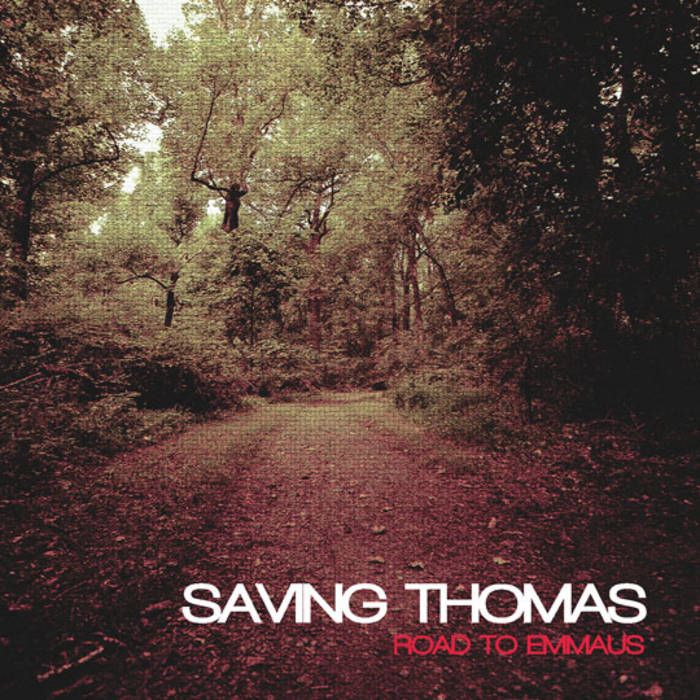
In Summer 2010, I interned at a studio in Philadelphia called Third Story Recording. It was run by Scott Herzog, a punk and hip-hop engineer who had recorded the early records by The Dead Kennedys. The studio basically recorded anyone who was willing to pay, so I ended up having to work on quite a few deeply unfortunate projects. As a result, the highlight of my day usually ended up being my work with Saving Thomas, a Korean Contemporary Christian group who combined folk rock and rapping. The group’s main songwriter was Dave Bak, a rapper, body percussionist, singer and rhythm guitarist. His songs were extremely religious in nature, but they were also very earnest and had a conviction to them which I found compelling – when Dave sang something, you could really tell he meant it. The band was being produced by their bassist, Bernard Chae, an incredibly talented individual who came up with some tasty bass lines and beautifully textured arrangements in addition to writing some music for the album. I ended up engineering quite a few of their sessions. Late one night when we were working on a song called ‘The Anatomy of Joy’, I told them I had some vocal layering ideas for the song (only minutes before I had to catch the train home). They hurriedly tracked me in the vocal booth – I threw a harmony idea at them which they rejected, then sang a contrasting line which they absolutely loved. Bernie ended up singing that part live, and every time he did it he looked like he was having the time of his life.
Soon after these sessions, Bernie quit his job as a lawyer and went to study music at Berklee. I originally asked him to perform the bass on Interior City, but he didn’t have time due to his studies.
I really enjoy the fact that my first two guest spots appeared on a Christian album and an Atheistic album (Being‘s upcoming debut, ‘Anthropocene’). This diversity of experiences has kept life rich!
Gabriel’s Notes: I think the opening of this was the first lyric written for the album. This is the album’s anthem, the main character’s manifesto… his entire worldview is described in this song.
The processed acoustic pianos which define much of the sound of ‘Interior City’ first appear at the start of this song. The opening chord progression is a six-chord sequence of parallel chords which increase in density throughout the song. They begin as four-note chords, expand into parallel diatonic clusters (featuring 6 of the 7 notes in the diatonic scale) in the second half, then become chromatic clusters where each note contains 10 out of the 12 chromatic tones in the 14-part violin chorale which ends the song. The ‘overtone chord’ voicing of this chorale is inspired by the way Messiaen frequently wrote extremely dissonant harmonies in his orchestral works but made them sound quite pleasing by placing the most dissonant notes in an extremely high register.
I originally wrote that 14-part violin chorale expecting that we wouldn’t get time to track it, but Sophia ended up breezing through all of her violin parts including the chorale in a day! I ended up devising new violin parts for Subway Dwellers and Defense Highway on the spot, replacing all of the string synth parts I had written with live violins – only the mellotron part in Ranting Prophet remains.
Tom added all sorts of cool embellishments to the bass lines in the second half of this song. The lead guitar tones and lines have a definite Failure influence… I even used the same Boss BF-2 flanger pedal they used to achieve the tones on their second album, ‘Magnified‘. Failure was probably the biggest rock influence on this album as a whole, and this is especially evident on Inner Sanctum.
Travis’s Notes: In Gabe’s original demo, the drums were super processed-sounding for the whole intro, but in my head I first heard them sounding gigantic and exaggerated. I opted to use two floor toms (my usual Reference Pure, along with a 16″x16″ Vision on my left) to express this, and further embellished the closed hat groove that follows — texturally — with my chunky 15″ MDM hats and an 8″x14″ Pearl maple snare (stock head).
Many months after tracking, Gabe kindly picked me up from the airport after my Drum Channel appearance, as he was in the middle of mixing the record at Oceanic and wasn’t far away. We were listening to a rough mix of the tune in the car and it was then that an idea/concept of how the second half of the intro could sound presented itself to me. I suggested a weird, crescendoing wall-of-noise affect into a roomy drum sound (2:38) and Gabe was into it. Killer!
When the song comes crashing back in after the brief break (3:30), the gear changes to my more commonly used brass Reference snare/rack tom. The cymbal setup is the same as in “Subway Dwellers”, although I used a ‘stack’ instead of a splash and an 18″ DRK flat ride on my right side.
There’s a ton of vocal complementation is this tune: 2:49, 3:09 (snare flams), 3:58 – 4:00 (cymbal melody), 4:10 – 4:12 (stack), 5:16 – 5:18 (stack), 5:18 – 5:22 (cymbal melody), 5:43 (stack), 6:28 – 6:30 (stack), 7:44 – 7:45 (cymbal melody). There’s also some tricky, syncopated fill-ins and a dual ride part at 6:38.
Lyrics: The story’s main character observes that everyone surrounding him seems just as uncomfortable with their existence in this realm as he is. They all cope with being alive by engaging in various forms of escapism – television and other media, religion and other frequently dogmatic forms of belief, hedonism and substance abuse…
As he watches others, he realizes the futility of his own fight against being alive. He tells himself that he needs to bring acceptance into his life or he will make himself miserable and waste his energy, but can’t bring himself to act on this, as the negativity in his mind is too strong.
Music: The main idea in this song is a rejected harmonization of a motive from the first movement of my string quartet (Listen to more movements here). This particular more rock-oriented harmonization didn’t quite fit with the piece, so I made a rock song out of it. The motive only appears briefly in the quartet, but it is repeated relentlessly here. It is paired with a tapping bass line written by Tom Murphy and a dual drum part. The left drum set is a 4/4 loop (a sampled ’80s Genesis drumbeat in my original demo, replaced by live drums in studio) which keeps running in 4/4 even when the song changes time signatures in the bridge. The idea of having two drum sets play polymetrically against each other is something that King Crimson explored in some of their dual-drum lineups, but it’s an idea which has been woefully underused in my opinion. The polymetric bridge is followed by a reprise of the piano/vocal opening, this time in a full band arrangement, accompanied by tremolo picked guitars and blastbeats (techniques drawn from extreme metal).
The instrumental interlude following the first verse is a direct quotation of an idea Messiaen used in used in quite a few of his earlyworks (and in one late work). Messiaen detested music with a constant pulse, but I have accompanied the quotation with a jazzy rhythm section playing a clear constant pulse, making the quotation rather sacrilegious.
My vocal approach through much of this song was largely inspired by Trent Reznor. The vocal embellishments at the full band entrance were inspired by traditional arabic music, and they are immediately followed by a section in which the guitar, saxophone, and violin all solo at once (simultaneous solos were common early big band jazz and in the music of Charles Mingus). The violin solo in this group, written and performed by Sophia Uddin, quotes the first movement of Bartók’s sixth string quartet. She plays a much longer violin solo to end the song, in which she quotes the second movement of Bartók’s second string quartet. You can hear a collaborative piece that Sophia and I wrote together here.
Piano video: I apologize that I look so serious and stoic throughout this video – I started out doing more energetic takes, but ended up getting more focused as I went along. The picture-in-picture bits weren’t actually used on the album – I recorded them as guide tracks for the guitar and violin. The line I’m playing in the first PIP continues to run while the second one is playing, but unfortunately there’s no way to make two PIPs play simultaneously in iMovie. My sister sat in for this session, and you can see her sitting in the control room.
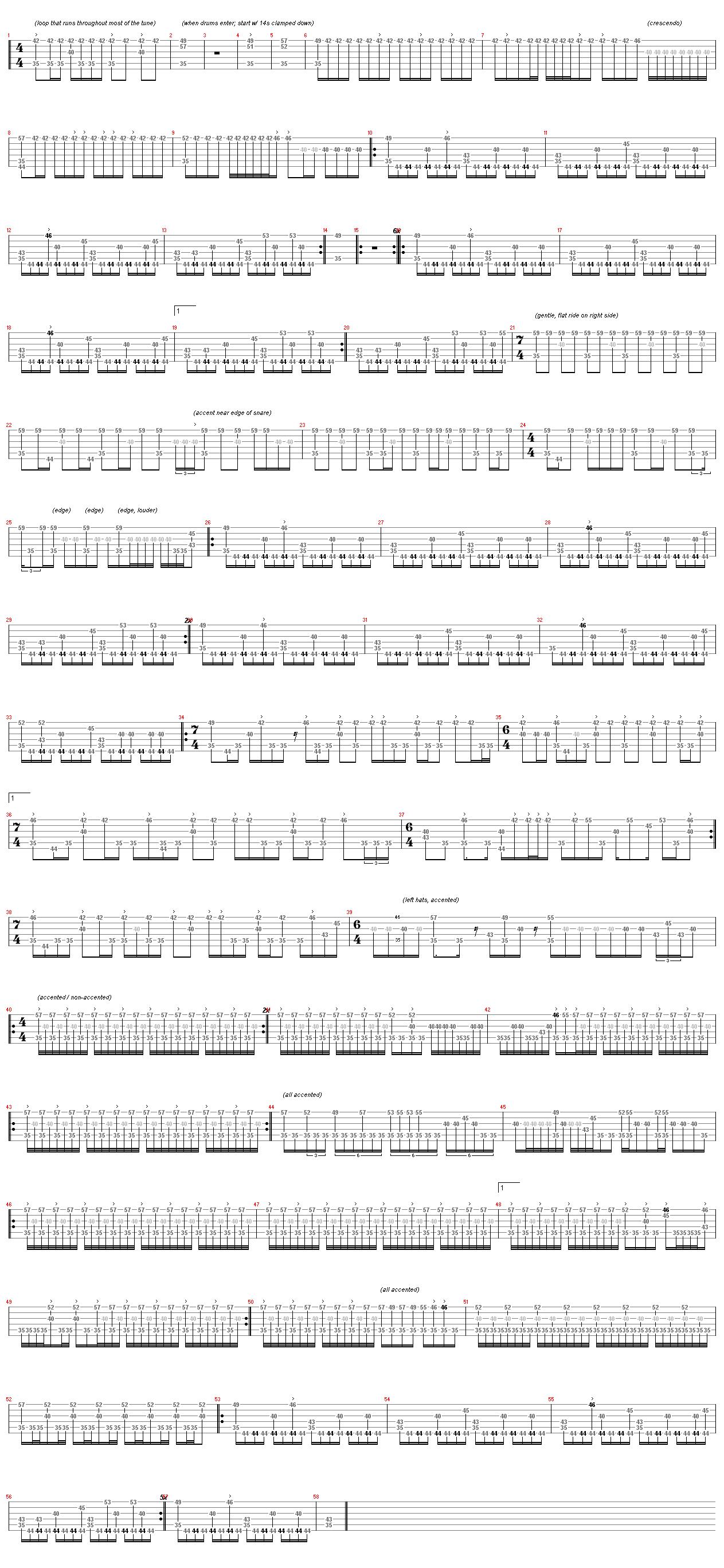
Travis’s notes: There’s a drum loop that runs throughout most of this tune that I tracked, but – regrettably – did not film (I included it in the first bar of the transcription). In Gabe’s original demo, the loop was lifted/sampled from a Genesis tune and I stuck pretty close to it. However, I wanted to retain a hand-to-hand hi-hat feel with tom-toms and other cymbal orchestrations poking through here and there, and what came out of me is what you see. My feet are playing a single stroke ostinato underneath, with the right foot moving back and forth between the right-side pedal hat and the bass drum. The ostinato dictated not only where within the bar but also which set of hats I choked.
In the section starting around 1:54, I employed some softer dynamics. There’s a cool over-the-bar polyrhythm at 2:07, then each subsequent ride strike is louder to segue back into the verse. At 2:45, the loop stays in 4-4 while the tune shifts between 7 and 6. The delayed snare backbeat at 3:08 complements the vocal. For the crazy blast-beat-driven bridge, I sought to punctuate it in spots; it usually starts at the tail end of the four-bar progression then bleeds into its repeat. There’s a two-bar tag at the end in which I play a ‘bomb blast’ in the first bar; I came up with the idea while tracking. Thankfully, my feet were cooperative that day haha.
Other appearances: This song appeared on the compilation CD for Zero Tolerance Issue #54 along with a review of the album. Their master of the song can be heard and downloaded below:
Websites store cookies to enhance functionality and personalise your experience. You can manage your preferences, but blocking some cookies may impact site performance and services.
Essential cookies enable basic functions and are necessary for the proper function of the website.
Name
Description
Duration
Cookie Preferences
This cookie is used to store the user's cookie consent preferences.
30 days
These cookies are needed for adding comments on this website.
Name
Description
Duration
comment_author
Used to track the user across multiple sessions.
Session
comment_author_email
Used to track the user across multiple sessions.
Session
comment_author_url
Used to track the user across multiple sessions.
Session
Statistics cookies collect information anonymously. This information helps us understand how visitors use our website.
Google Analytics is a powerful tool that tracks and analyzes website traffic for informed marketing decisions.
Contains information related to marketing campaigns of the user. These are shared with Google AdWords / Google Ads when the Google Ads and Google Analytics accounts are linked together.
90 days
__utma
ID used to identify users and sessions
2 years after last activity
__utmt
Used to monitor number of Google Analytics server requests
10 minutes
__utmb
Used to distinguish new sessions and visits. This cookie is set when the GA.js javascript library is loaded and there is no existing __utmb cookie. The cookie is updated every time data is sent to the Google Analytics server.
30 minutes after last activity
__utmc
Used only with old Urchin versions of Google Analytics and not with GA.js. Was used to distinguish between new sessions and visits at the end of a session.
End of session (browser)
__utmz
Contains information about the traffic source or campaign that directed user to the website. The cookie is set when the GA.js javascript is loaded and updated when data is sent to the Google Anaytics server
6 months after last activity
__utmv
Contains custom information set by the web developer via the _setCustomVar method in Google Analytics. This cookie is updated every time new data is sent to the Google Analytics server.
2 years after last activity
__utmx
Used to determine whether a user is included in an A / B or Multivariate test.
18 months
_ga
ID used to identify users
2 years
_gali
Used by Google Analytics to determine which links on a page are being clicked
30 seconds
_ga_
ID used to identify users
2 years
_gid
ID used to identify users for 24 hours after last activity
24 hours
_gat
Used to monitor number of Google Analytics server requests when using Google Tag Manager
1 minute
Marketing cookies are used to follow visitors to websites. The intention is to show ads that are relevant and engaging to the individual user.
A video-sharing platform for users to upload, view, and share videos across various genres and topics.
Registers a unique ID on mobile devices to enable tracking based on geographical GPS location.
1 day
VISITOR_INFO1_LIVE
Tries to estimate the users' bandwidth on pages with integrated YouTube videos. Also used for marketing
179 days
PREF
This cookie stores your preferences and other information, in particular preferred language, how many search results you wish to be shown on your page, and whether or not you wish to have Google’s SafeSearch filter turned on.
10 years from set/ update
YSC
Registers a unique ID to keep statistics of what videos from YouTube the user has seen.
Session
DEVICE_INFO
Used to detect if the visitor has accepted the marketing category in the cookie banner. This cookie is necessary for GDPR-compliance of the website.
179 days
LOGIN_INFO
This cookie is used to play YouTube videos embedded on the website.



 In Summer 2010, I interned at a studio in Philadelphia called Third Story Recording. It was run by Scott Herzog, a punk and hip-hop engineer who had recorded the early records by The Dead Kennedys. The studio basically recorded anyone who was willing to pay, so I ended up having to work on quite a few deeply unfortunate projects. As a result, the highlight of my day usually ended up being my work with Saving Thomas, a Korean Contemporary Christian group who combined folk rock and rapping. The group’s main songwriter was Dave Bak, a rapper, body percussionist, singer and rhythm guitarist. His songs were extremely religious in nature, but they were also very earnest and had a conviction to them which I found compelling – when Dave sang something, you could really tell he meant it. The band was being produced by their bassist, Bernard Chae, an incredibly talented individual who came up with some tasty bass lines and beautifully textured arrangements in addition to writing some music for the album. I ended up engineering quite a few of their sessions. Late one night when we were working on a song called ‘The Anatomy of Joy’, I told them I had some vocal layering ideas for the song (only minutes before I had to catch the train home). They hurriedly tracked me in the vocal booth – I threw a harmony idea at them which they rejected, then sang a contrasting line which they absolutely loved. Bernie ended up singing that part live, and every time he did it he looked like he was having the time of his life.